

Boat Flooring Order Confirmation Checklist for Marine Retailers
An accepted quote is not yet a safe boat flooring order. Between the customer saying "yes" and a retailer releasing material, small ambiguities can turn into costly problems: the sample shown at the counter is not the pattern on the order, a hand measurement is mistaken for a cut file, a stock-sheet sale is treated as a custom kit, or a delivery expectation is repeated as though it were confirmed.
The order-confirmation step prevents that drift. It is a short, traceable review that turns an accepted discussion into a clear instruction for the retailer, customer, installer, cutter, distributor, or supplier. It should not create new promises about fit, availability, lead time, or performance. Its job is to make sure the parties know exactly what has-and has not-been agreed before the order moves forward.
Treat the Accepted Quote as a Starting Record
Start with the version of the quote the customer accepted. Do not rebuild the order from a salesperson's memory, a text-message summary, or a photo of a sample board. Put the quote reference, customer name, date, and the person confirming the order in one record. If the customer has changed anything since the quote, label it as a revision instead of silently folding it into the old scope.
The retailer's earlier conversation belongs in the record too, but it has a different purpose. The boat flooring customer intake guide for marine retailers helps staff collect early facts and route a request. Order confirmation begins after that work: it checks whether the facts that supported the quote are still the facts that support the release.
This distinction matters when a buyer first asks for "new deck foam," then later chooses a different color, asks for cut pieces, adds a hatch area, or changes who will install it. None of those updates are inherently difficult. The risk comes from treating them as casual notes rather than changes to the order basis.
Confirm the Material by More Than a Color Name
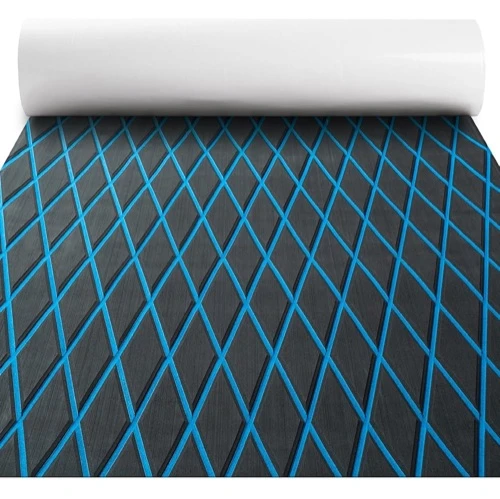
"Gray with blue lines" is not a complete material description. Retailers should record the exact customer-approved pattern or sample reference, the visible color combination, the surface texture, the requested format, and the backing choice when applicable. If staff cannot identify an element from the accepted quote, they should pause and ask rather than infer it from a customer photo or a similar display sample.
Use a simple confirmation line that the customer can understand: material reference, color or pattern reference, requested quantity or pieces, and whether the order is a stock sheet, cut-to-size request, or custom review. This is more useful than a long product description copied into an email, because it makes mismatches easy to spot before release.
If adhesive backing is part of the request, confirm it separately. A visual sample cannot establish the backing requirement, installation readiness, or the customer's installation responsibility. The marine deck adhesive backing guide gives buyers a useful vocabulary for that discussion; the order record should capture the final requested configuration without claiming that a particular backing solves every installation condition.
Name the Order Route Before Confirming Measurements
Retailers commonly handle three different order routes: sale of stock material for the buyer to manage, local cut-to-size work, and a custom project that needs a drawing or template review. The confirmation checklist should say which route applies. It should never present a hand measurement as a verified custom cutting instruction just because a customer sent it over a phone.
For a stock-material sale, record the sheet or roll quantity and state who measures, trims, and installs. For cut-to-size work, attach the measurement source, unit, orientation notes, and the customer's approval of the cut scope. For a custom project, record the drawing or template version, the date received, and any unresolved questions about hatches, hardware, seams, or boundaries. The marine deck drawing and template guide can help a buyer prepare that source material before the order moves forward.
The goal is not to turn a retailer into an engineering approver. It is to ensure that everyone knows whether the order is based on a material quantity, a local cutting instruction, or a separate custom review. If that is not clear, the order is not ready to release.
Put Responsibility in Plain Language
A confirmation should name the role of each party. Who supplied the measurements? Who approved the color and pattern? Who will cut the material? Who will remove the old flooring, prepare the substrate, and install the new material? Who will receive the delivery? A short answer beside each responsibility is enough.
This is not blame language. It is practical routing. For example, a retailer can document that the customer is buying a stock sheet and will make the final cuts, or that a local cutter is working from a customer-approved measurement sheet. The record does not need to predict success or failure. It needs to avoid the later claim that someone else was expected to make a decision that was never assigned.
If the scope includes a changed hatch, new deck hardware, a worn substrate, or uncertain old adhesive, do not hide the uncertainty inside a generic "boat flooring" line item. Add a note that the point remains to be checked before installation. This keeps an order confirmation factual and prevents a counter conversation from becoming an unsupported warranty or fit promise.
Check Quantity, Piece Count, and Waste Assumptions
Retailers should compare the accepted material quantity with the route chosen for the job. A stock-sheet order may need an intentional allowance for buyer trimming; a cut-to-size order may need a defined piece count; a custom review may not yet be ready for a final quantity. Do not invent a universal allowance, because the required material depends on the layout, cutting plan, and responsibility assigned to the buyer or cutter.
Instead, record what the quote actually covers. If the buyer wants extra material for a repair or a future test piece, add it as an explicit line rather than assuming it is included. If the customer asks for a "full kit," define what areas are inside that phrase and which areas are excluded. A hatch cover, swim step, vertical face, or removable panel should not appear only in a conversation note.
The existing boat flooring cut-to-size program guide is useful when a request moves beyond a simple stock sale. It explains why a clear local workflow is safer than treating every customer measurement as ready-to-cut data.
Separate Delivery Planning From Product Confirmation
Customers often hear an informal delivery comment while they are choosing samples. That is not a reason to copy it into an order as a guaranteed date. Confirm the delivery destination, receiver, contact method, access restrictions, and whether the customer, store, installer, or freight handler is expected to receive the material. Keep any timing estimate separate from the material confirmation and subject to the appropriate order or shipping review.
For orders involving a distributor, supplier, or longer delivery chain, ask what document or reference the receiving team will use to identify the material and piece count. The marine deck freight planning guide offers a broader checklist for that handoff. At the retail level, the minimum is still valuable: make sure the recipient, destination, order reference, and expected contents are visible before release.
Avoid statements such as "arrives by Friday" or "ready for any boat" unless they have been separately verified and approved. A confirmation record can say that delivery details remain subject to final confirmation. That is clearer than a reassuring but unsupported promise.
Get One Clear Approval Record
The final step is simple: send the confirmation in a form the customer can review, then save the response with the quote and any attached drawing, template, or photo set. The customer should be able to see the material reference, order route, quantity or pieces, responsibility notes, and delivery details in one place. If the customer corrects anything, issue a revision rather than editing the old confirmation without a trace.
The confirmation does not need legal language or a complicated portal. It needs a clear date, version, and approval record. That record helps the retailer answer later questions, supports a cleaner handoff to a cutter or supplier, and reduces the chance that a final order is assembled from several conflicting messages.
When a retailer contacts XYF Marine about a boat flooring order, the most useful handoff is the accepted quote, material reference, order route, measurement source, responsibility notes, delivery context, and the customer's final approval. XYF Marine can review the information provided and identify details that still need confirmation before quotation, sampling, or order preparation.
FAQ
Is order confirmation the same as customer intake?
No. Customer intake collects early facts so the retailer can recommend a path. Order confirmation checks the final agreed scope after a quote is accepted and before material is released.
Can a retailer confirm an order from a boat photo alone?
Usually not. A photo may help identify the project context, but it does not reliably establish the selected material, exact dimensions, cut responsibility, or order route. Record the photo as supporting information, not as a substitute for approval details.
What if the customer changes the pattern after accepting the quote?
Create a revision. Reconfirm the material reference and any quantity, price, measurement, or delivery impact before the order moves forward. Do not rely on a verbal change to update a prior confirmation.
Should the retailer promise a delivery date in the confirmation?
Only include a delivery commitment if it has been separately verified by the responsible party. Otherwise, record the destination and receiving details, and state that timing requires final confirmation.