

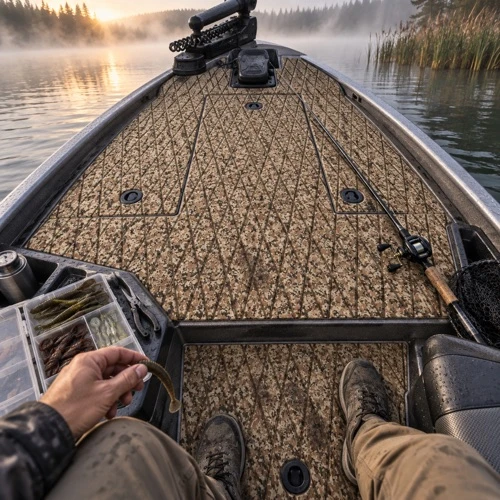
Bass Boat Flooring Fitment Guide for Marine Supply Stores
Bass boat flooring requests often arrive as a simple retail question: a customer wants a cleaner deck surface, a better-looking casting platform, or replacement pieces for a boat that sees regular fishing use. For a marine supply store, the risk is that the request sounds narrow while the fitment details are not narrow at all.
This bass boat flooring guide gives store teams a practical workflow for qualifying the project before recommending samples, selling sheet material, cutting pieces, or collecting information for supplier review. It focuses on the details that make bass boats different from a general deck flooring conversation: casting decks, trolling motor areas, hatch lids, pedestal bases, rod and tackle workflow, wet footwear, and customer-supplied measurement risk.
Start With the Fishing Workflow
The first question is not color. It is how the boat is used. A tournament-style bass boat, a weekend fishing boat, and an older aluminum bass rig may all need flooring, but the traffic pattern can be different.
Store staff should ask where the angler stands most often, whether the front casting deck is the priority, whether the rear deck also needs coverage, and whether the customer uses the boat alone or with a partner. The goal is to identify the zones that affect movement, gear access, and comfort before the conversation moves to pattern or price.
If the buyer is still comparing broader boat categories, the XYF Marine article on choosing marine deck flooring for different boats can provide a wider starting point. This page narrows the discussion to bass boat fitment.
Separate the Bow Deck From the Cockpit Area
A bass boat should not be treated as one flat rectangle. The bow casting deck, cockpit floor, seat pedestal area, rear deck, steps, and storage lids may each create different decisions.
The bow deck usually gets the most attention because it is where the angler stands, moves, casts, kneels, and reaches for gear. The cockpit area may have tighter transitions around consoles and seats. The rear deck may have lids, pedestal points, or engine-side movement that needs a separate review.
This zone-by-zone conversation helps the store avoid a common quoting mistake: assuming the customer wants every visible area covered in the same way. Some customers only want the worn platform refreshed. Others expect a full coordinated deck plan.
Document Hatches, Lids, and Hardware Early
Bass boats often have storage lids, livewell lids, drain openings, handles, latches, hinges, seat bases, trolling motor mounts, electronics brackets, and rod-storage access points. These details matter because flooring pieces may need to stop short, wrap around hardware, or preserve lid operation.
Before a store accepts a cut-to-size or custom quote request, it should ask for clear photos of every target zone with hatches closed and open. It should also ask whether any hardware has been changed from the original layout. A small aftermarket bracket or replaced latch can create a fit issue if the project is treated as a standard deck.
For more detailed layout preparation, the XYF Marine drawing and template guide for custom boat flooring projects is a useful companion because it explains why photos, drawings, and approval notes must work together.
Clarify Who Owns Measurement Responsibility
Measurement responsibility should be made clear before the store quotes anything beyond a basic material sale. If the customer supplies dimensions, the order record should say so. If the store measures the boat, the store should document what was measured, what was excluded, and whether the measurements are intended for material estimating, cutting, or supplier review.
This point is especially important around hatch lids and tight edges. A piece that looks close enough in a casual sketch may still interfere with a latch, hinge movement, or panel gap. The store does not need to overcomplicate every retail sale, but it should avoid letting the customer believe fit has been confirmed when the store has not controlled the measurement process.
The XYF Marine CNC tolerance guide can support this discussion when a customer expects close-fitting pieces around deck features.
Treat Pattern Direction as a Fitment Decision
Pattern direction is not only an appearance choice. On a bass boat, the customer may look down the length of the bow deck while casting, step across lids, and view the flooring from the cockpit or dock. If adjacent pieces run in conflicting directions, the finished deck can look less intentional even when the material itself is attractive.
Store teams should ask whether the buyer wants the pattern to follow the centerline, align across multiple hatch lids, or prioritize a specific visible zone. If a store is preparing cut pieces, it should record pattern direction before cutting or supplier review. If the sale is material-only, the customer should understand that layout planning remains part of installation.
This is a simple conversation, but it prevents a surprising number of after-sale disagreements.
Use Samples to Check Color, Scale, and Surface Feel
Samples are valuable because bass boat flooring is seen in outdoor light, around dark hardware, near rods and tackle, and often under wet or dusty use. A pattern that looks mild indoors can read differently on a wide casting deck. A color that looks clean in a catalog may show dirt differently after regular fishing trips.
The store should encourage the customer to compare samples near the boat when practical, or at least in daylight. The buyer should review color, surface feel, visual scale, and how the pattern works with seats, console color, hull color, and hardware.
This keeps the store's advice grounded in what the buyer can actually inspect. It also reduces pressure to make unsupported performance promises from a photo alone.
Decide the Sales Path Before Collecting Too Much Detail
Every bass boat flooring request should be placed into one of three paths. The first is a material sale, where the customer buys sheet material and manages measuring, cutting, and installation. The second is a store-supported cut-to-size sale, where the store needs dimensions, pattern direction, and written approval. The third is a supplier-review path, where the project needs better photos, drawings, templates, or other information before anyone treats it as ready.
Marine supply stores can use the XYF Marine boat flooring cut-to-size program guide to build the operational side of this workflow. The important point is that the customer should know which path they are on.
If the path is unclear, the store should pause before quoting. A pause at intake is less painful than a dispute after cutting.
Check the Existing Deck Condition
A bass boat flooring project can be affected by old carpet, adhesive residue, damaged panels, soft areas, moisture, previous repairs, or uneven surfaces. The store does not need to inspect every boat in person, but it should ask enough questions to identify whether the customer is describing a cosmetic upgrade or a repair-sensitive project.
If the buyer has not removed the old flooring, staff should avoid assuming the surface will be ready. If the customer reports soft spots, loose panels, heavy residue, or unknown repairs, the store should recommend resolving those questions before the flooring order moves forward.
For broader fishing and workboat use cases, the existing XYF Marine article on EVA marine deck for fishing boats and workboats can support buyers who need a general application overview.
Build a Bass Boat Intake Checklist
A practical intake checklist should capture the boat type, target zones, photos received, hatch and lid notes, hardware changes, sample status, pattern direction, deck condition, measurement responsibility, installation plan, and unresolved fit risks.
The checklist should also record whether the customer expects the store to provide material only, cut pieces, or supplier coordination. This one line protects both sides. It keeps the buyer from assuming hidden services are included, and it helps staff hand off the project internally without losing context.
Good intake notes are also useful when the same customer returns for additional pieces, seasonal repairs, or a matching rear-deck request.
Avoid Common Bass Boat Flooring Mistakes
The biggest mistake is quoting from a partial photo set. A second mistake is ignoring hatch operation. A third is treating pattern direction as decoration after the layout has already been decided.
A better workflow is steady and repeatable: qualify the fishing use case, map the deck zones, document hatches and hardware, clarify measurement responsibility, review samples, confirm pattern direction, check deck condition, then choose the sales path. This gives the buyer a clearer experience and gives the store a stronger project record.
FAQ
What should a store ask before quoting bass boat flooring?
Ask which zones need coverage, how the boat is used, whether hatches and hardware are involved, who owns measurements, whether samples have been reviewed, what pattern direction is expected, and whether the sale is material-only, cut-to-size, or supplier-reviewed.
Can a bass boat flooring order be based only on photos?
Photos are useful, but they are not enough for every project. Tight fitment around hatches, latches, trolling motor areas, and deck edges usually needs clearer measurements, layout notes, or a more controlled approval process.
When should the store move from retail sale to supplier review?
Move toward supplier review when the buyer expects close-fitting pieces, coordinated pattern direction across multiple lids, complex hardware clearances, or support beyond a simple material sale.
Work With XYF Marine on Bass Boat Flooring Requests
When discussing bass boat flooring with XYF Marine, send the target deck zones, photos, hatch and hardware notes, sample preferences, pattern direction, measurement assumptions, existing deck concerns, and the intended sales path. Clear intake information helps turn a loose retail request into a better flooring specification before the order path is chosen.